SEO / AEO
If an AI Can't Explain What You Do, You've Already Lost the Room
How AI Systems Interpret Search Queries
Traditional SEO was built around ranking pages inside search results. The process was relatively straightforward: identify keywords people searched for, create pages targeting those terms, build authority through links, and compete for visibility.
That framework still matters, but it no longer explains how discovery works across modern AI systems.
When someone asks ChatGPT, Perplexity, or Google AI Overviews a question, the system is not simply scanning for exact keyword matches. It is trying to interpret intent, context, relationships, and topical relevance before generating a response.
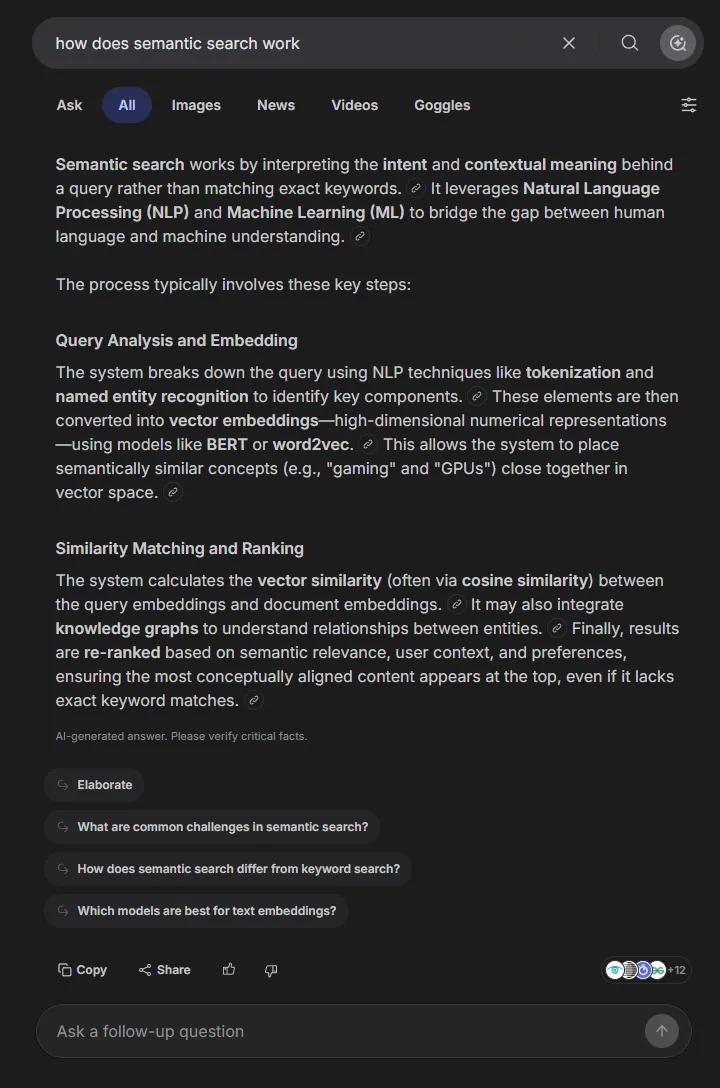
The screenshot above illustrates how semantic search systems increasingly process information. Instead of relying entirely on keyword matching, these systems use natural language processing, embeddings, entity relationships, and contextual ranking models to understand what a query is actually asking.
That distinction changes how visibility works online.
A website may still rank for a keyword while remaining difficult for AI systems to confidently interpret or recommend. In many cases, retrieval systems favor brands that communicate their expertise clearly and consistently rather than brands that simply publish the highest volume of content.
During retrieval testing across ChatGPT, Perplexity, Brave Search, and Google AI Overviews, a recurring pattern became obvious. Brands with stronger semantic clarity surfaced more reliably, even when they were not the largest companies in their category.
The companies that performed best usually shared a few characteristics:
- clear positioning
- strong topical consistency
- aligned terminology across pages
- recognizable expertise signals
- contextual relevance within a category
The common thread was not aggressive optimization. It was clarity.
Modern discovery systems increasingly reward websites that are easy to interpret contextually. That is a very different problem from simply ranking for keywords.
Why Semantic Clarity Changes AI Interpretation
One of the more surprising patterns during AI retrieval testing was how often modern websites sounded impressive while communicating very little clearly.
The branding looked polished. The websites felt premium. The messaging used familiar startup and marketing language. But when those same positioning statements were tested inside AI systems, the interpretations were usually vague and generalized.
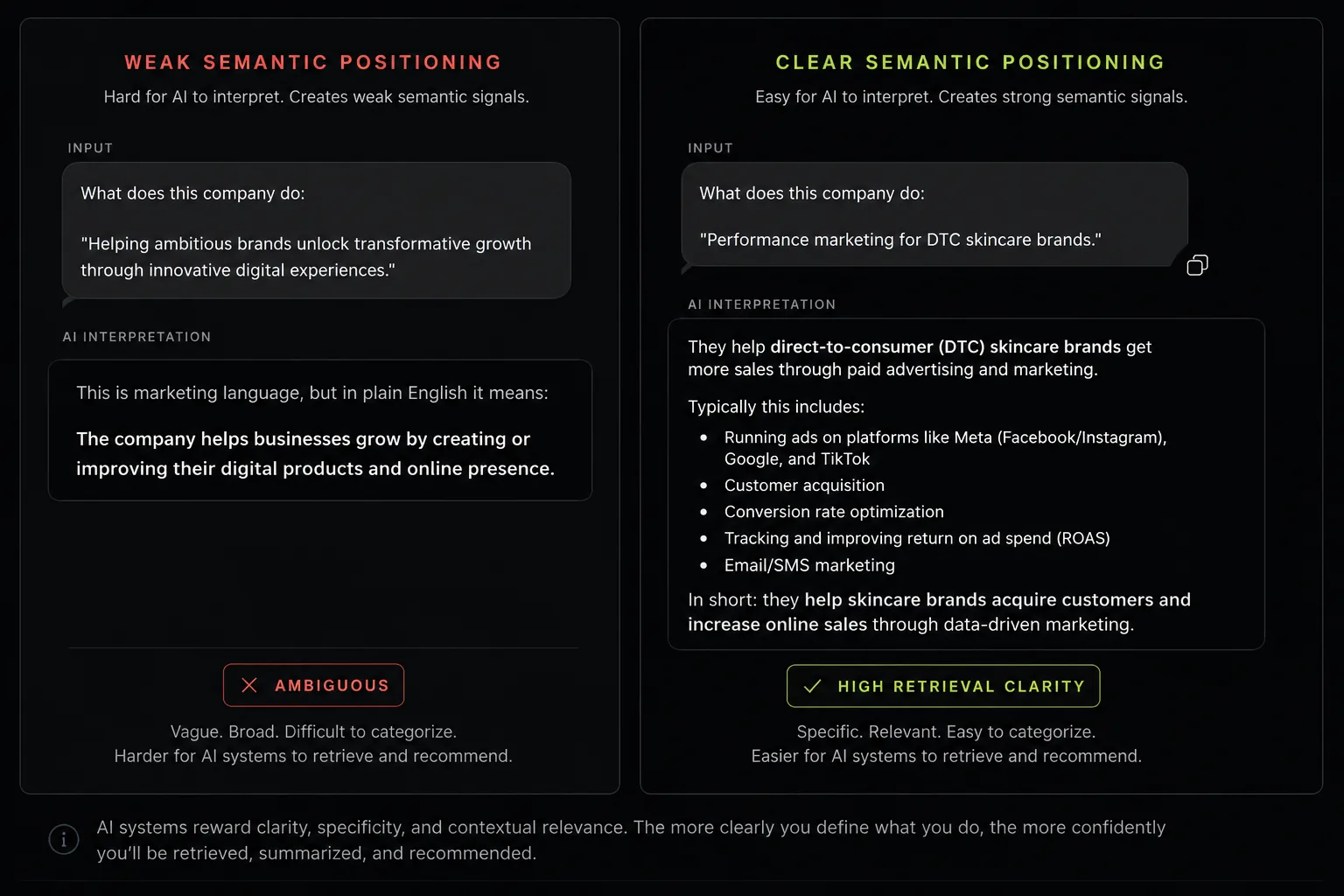
The image above demonstrates this clearly.
On the left, the positioning sounds modern and aspirational:
“Helping ambitious brands unlock transformative growth through innovative digital experiences.”
A human reader may understand the tone the company is trying to create, but the statement still leaves major questions unanswered. What kind of company is it? Who does it serve? What category does it belong to? What specific expertise does it actually have?
Because the positioning lacks specificity, the AI system fills in the gaps with broad assumptions.
The second example creates a completely different result:
“Performance marketing for DTC skincare brands.”
That single sentence immediately establishes:
- the service category
- the target customer
- the business model
- the area of expertise
- the contextual relevance
The interpretation becomes far more precise because the semantic signals are clearer.
This is where many brands currently struggle. Their websites are optimized heavily for aesthetics and persuasion, but not for comprehension. AI systems cannot confidently retrieve or recommend brands they cannot clearly categorize.
The goal is not to write robotic copy or stuff pages with keywords. The goal is to reduce ambiguity so both humans and machines can understand what the business actually does and why it is relevant within a specific context.
That clarity compounds across retrieval systems, search engines, AI summaries, and recommendation layers.
How AI Discovery Infrastructure Actually Works
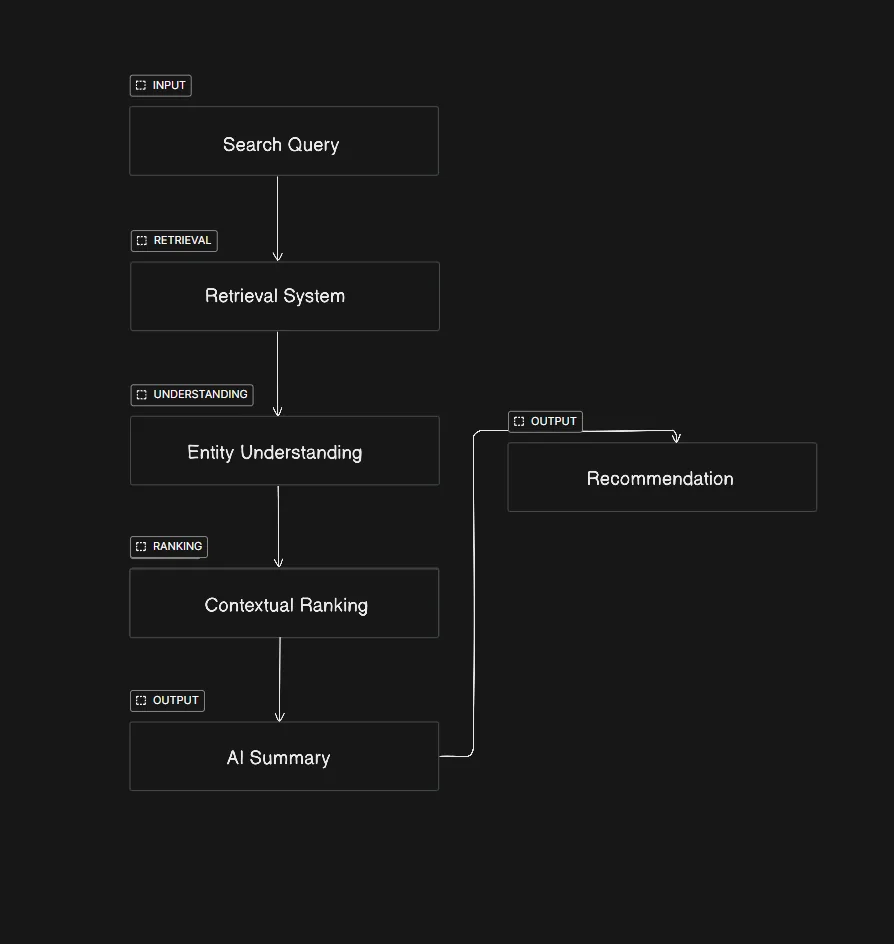
AI discovery systems rely on far more infrastructure than traditional search engines did.
A modern retrieval pipeline usually involves multiple layers working together:
- semantic search
- entity understanding
- contextual ranking
- retrieval models
- knowledge graphs
- answer synthesis systems
The diagram above simplifies that process visually.
A search query first enters a retrieval system designed to interpret the intent behind the question. The system then evaluates entities, contextual relationships, semantic similarity, and topical relevance before ranking information based on confidence and usefulness.
Only after those steps does the AI system generate a summarized recommendation or response.
This shift is creating entirely new optimization categories focused on discoverability inside AI-generated environments.
AEO
Answer Engine Optimization focuses on structuring information so AI systems can interpret, summarize, cite, and retrieve it more confidently.
As conversational search behavior increases, this becomes increasingly important because users are asking more detailed and contextual questions instead of typing short keyword phrases.
GEO
Generative Engine Optimization focuses more specifically on discoverability inside AI-generated responses.
Instead of optimizing purely for rankings, GEO focuses on improving:
- retrievability
- semantic structure
- contextual clarity
- information architecture
Read: What Is Generative Engine Optimization (GEO)?
Entity SEO
Entity SEO focuses on helping search and AI systems build a clearer understanding of what a brand, company, or creator actually represents.
That understanding is shaped through:
- semantic consistency
- topical authority
- structured data
- contextual relationships
- external references
Read: What Is Entity SEO — And Why Does It Change Everything?