SEO / AEO
What Is Generative Engine Optimization (GEO)?
Search did not disappear. What changed was the interface through which people discover information.
For years, online visibility was mostly a ranking problem. Brands competed for placement inside search results by targeting keywords, publishing content, building backlinks, and improving domain authority. That framework still matters, but it no longer explains the full picture of how discovery works online.
Increasingly, users are interacting with systems that generate answers instead of simply presenting lists of websites.
ChatGPT summarizes information conversationally. Perplexity synthesizes sources into direct responses. Google AI Overviews compress entire categories into a few paragraphs before a user even clicks a result.
This changes how visibility functions.
Discovery is becoming less dependent on whether a page ranks first and more dependent on whether a system can confidently retrieve, interpret, and synthesize information about a brand.
That shift is where Generative Engine Optimization — commonly shortened to GEO — starts becoming important.
Why GEO Is Different From Traditional SEO
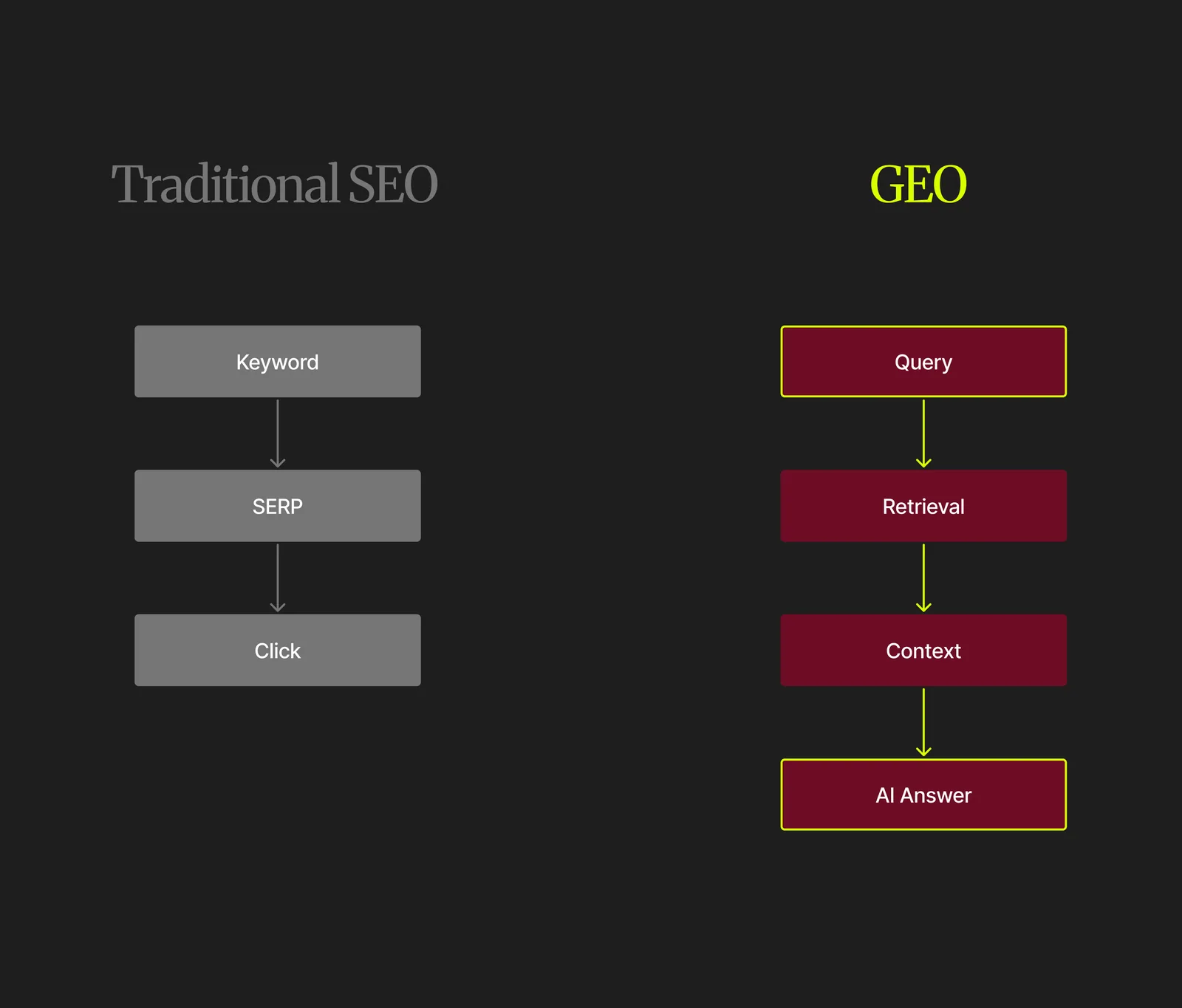
One of the most common misunderstandings around GEO is treating it as “SEO for AI.”
That framing oversimplifies what is actually happening.
Traditional SEO focused heavily on helping search engines rank webpages. GEO is more closely tied to how AI systems retrieve and interpret contextual understanding.
When a generative system produces an answer, it needs enough confidence to understand:
- what a company does
- what category it belongs to
- what expertise it demonstrates
- how it relates to other entities and topics
That process relies heavily on semantic clarity.
A surprising number of websites still communicate very little concrete meaning despite having polished branding and strong visual design. Many companies rely on broad positioning language that sounds modern but lacks contextual specificity.
Phrases like:
- “innovative digital experiences”
- “results-driven growth”
- “transformative solutions”
may sound polished to human readers, but they often generate weak semantic signals inside retrieval systems.
The issue is not aesthetics. The issue is ambiguity.
When AI systems struggle to confidently categorize a business, retrieval becomes weaker and discoverability suffers.
AI Discovery Is Becoming A Retrieval Problem
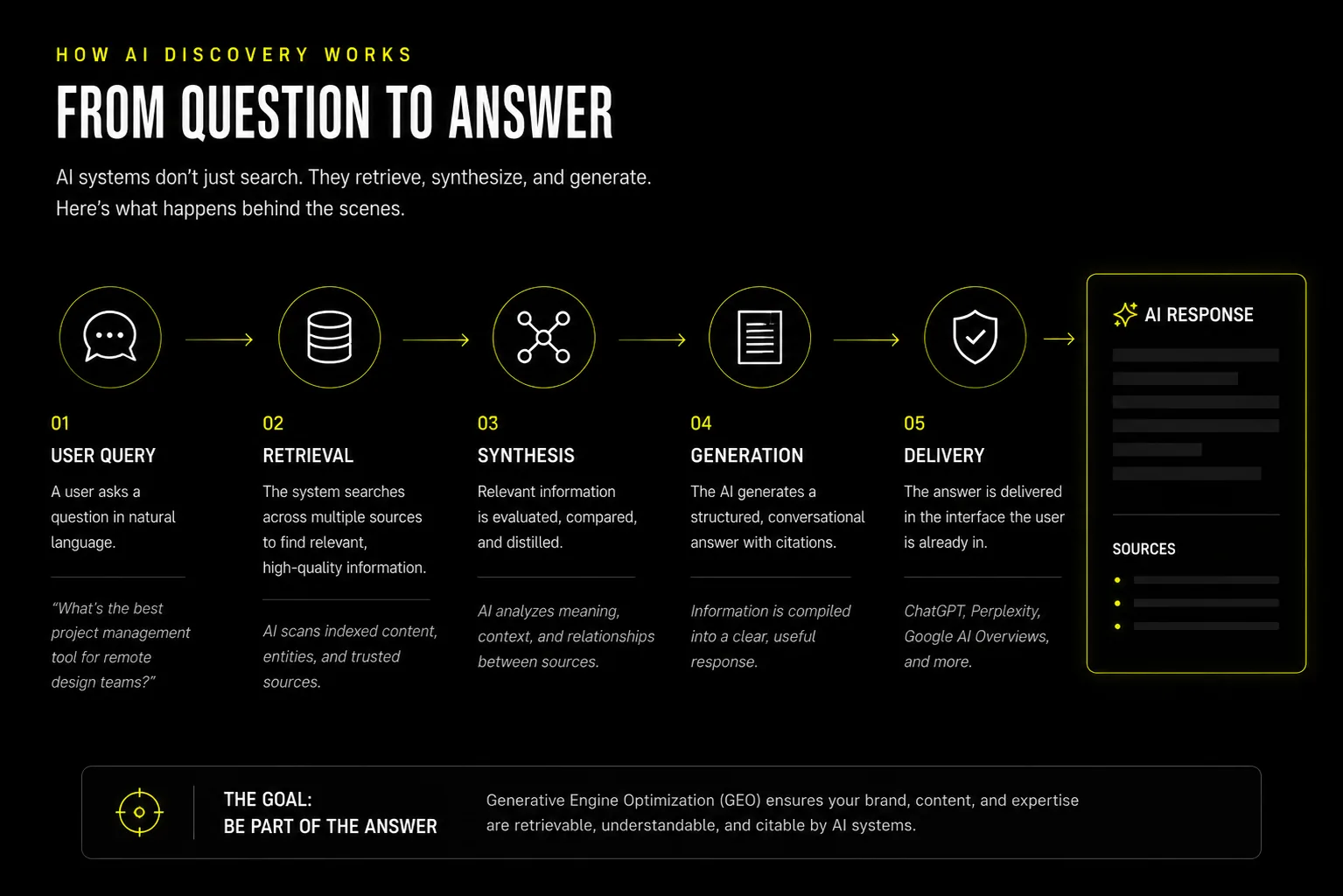
Modern AI discovery systems do far more than “find websites.”
They retrieve, evaluate, synthesize, and contextualize information before generating a response. That process usually involves multiple layers working together, including:
- semantic search
- contextual ranking
- entity relationships
- topical relevance
- retrieval models
- answer synthesis systems
The image above illustrates this shift visually.
A query enters a retrieval system that attempts to interpret meaning and intent rather than simply match keywords. Information is then evaluated contextually before a summarized recommendation or answer is generated.
This changes the qualities that make brands discoverable.
During testing across systems like ChatGPT, Perplexity, Brave Search, and Google AI Overviews, brands that surfaced consistently usually shared a few characteristics:
- clear positioning
- strong topical consistency
- structured information
- recognizable expertise
- contextual relevance within a category
The strongest-performing brands were not always the biggest brands. They were often the easiest to understand.
That distinction matters more than many companies realize.
Why Entity SEO Is Becoming Core Infrastructure
Search engines and AI systems increasingly rely on entity relationships instead of purely evaluating keyword frequency.
That means visibility is becoming more dependent on whether systems can understand contextual relationships between:
- brands
- people
- products
- concepts
- industries
- expertise areas
This is where Entity SEO becomes foundational.
Entity SEO focuses on building semantic consistency across:
- websites
- metadata
- editorial content
- structured data
- external references
- topical relationships
The objective is not simply ranking individual pages. The larger goal is helping AI systems build a clearer understanding of what a company actually represents.
Read: What Is Entity SEO — And Why Does It Change Everything?
The clearer those relationships become, the easier retrieval becomes.
Most Brands Still Think In Campaigns
A large percentage of companies still approach visibility tactically instead of structurally.
The focus often stays centered around:
- publishing volume
- trend chasing
- keyword targeting
- short-term traffic spikes
- isolated campaigns
The result is usually fragmented semantic signals.
Content gets published without building topical depth or contextual relationships between ideas. Internal linking remains weak. Positioning shifts from page to page. The brand becomes difficult to categorize consistently.
Many businesses do not actually have a content ecosystem.
They have disconnected content activity.
That distinction becomes increasingly important as AI systems rely more heavily on semantic understanding and contextual consistency.
Brands with stronger discoverability infrastructure tend to create:
- clearer topical relationships
- aligned terminology
- stronger entity associations
- more structured information architecture
- deeper contextual relevance
Those signals compound over time.
Search Interfaces Are Becoming Compressed
AI systems are increasingly compressing:
- research
- comparisons
- recommendations
- summaries
- decision-making
into a single interface layer.
This changes how users form opinions.
In many cases, users now encounter an AI-generated interpretation of a company before ever visiting the company’s website directly.
That means positioning increasingly influences retrieval systems before it influences human readers.
A homepage is no longer guaranteed to be the first impression.
The model’s interpretation of the brand might be.
That makes semantic clarity significantly more important than it was in traditional search environments.
Conclusion
Generative Engine Optimization is ultimately a response to a broader shift in how discovery systems operate.
Search is becoming increasingly:
- semantic
- contextual
- retrieval-driven
- entity-aware
- generative
The brands most likely to perform well in these environments are usually not the brands producing the highest volume of content. They are the brands that communicate their expertise clearly, structure information effectively, and build stronger contextual understanding across the web.
As AI systems become more involved in mediating the relationship between users and information, ambiguity becomes increasingly expensive.
Brands that are difficult to interpret become difficult to retrieve.